With it being such an iconic part of Toyota’s high-mpg lineup, it’s no surprise the Prius has been around for almost 30 years. Introduced in Japan in 1997 as the first mass-produced hybrid passenger car, it reached the U.S. three years later as a compact sedan. Five generations on, the 2023 redesign brought a far more sporty, streamlined look, lower stance, and significantly more power. A plug-in hybrid variant has been part of the lineup since the third generation. In recent years, Toyota has dropped the “Prime” label, now simply calling them PHEV models. New for 2026, the popular Nightshade trim reaches the Prius, adding the now-familiar blacked-out accents seen across much of the Toyota lineup.
Twenty years ago, I owned a light blue Prius and liked it as a personal vehicle, though its storage space back then was a challenge with three kids and their musical instruments. Indeed, one afternoon trying to jenga a cello into the vehicle after school convinced me it no longer served my needs: The next morning, I traded it in for a Toyota Highlander Hybrid. But that's another story...
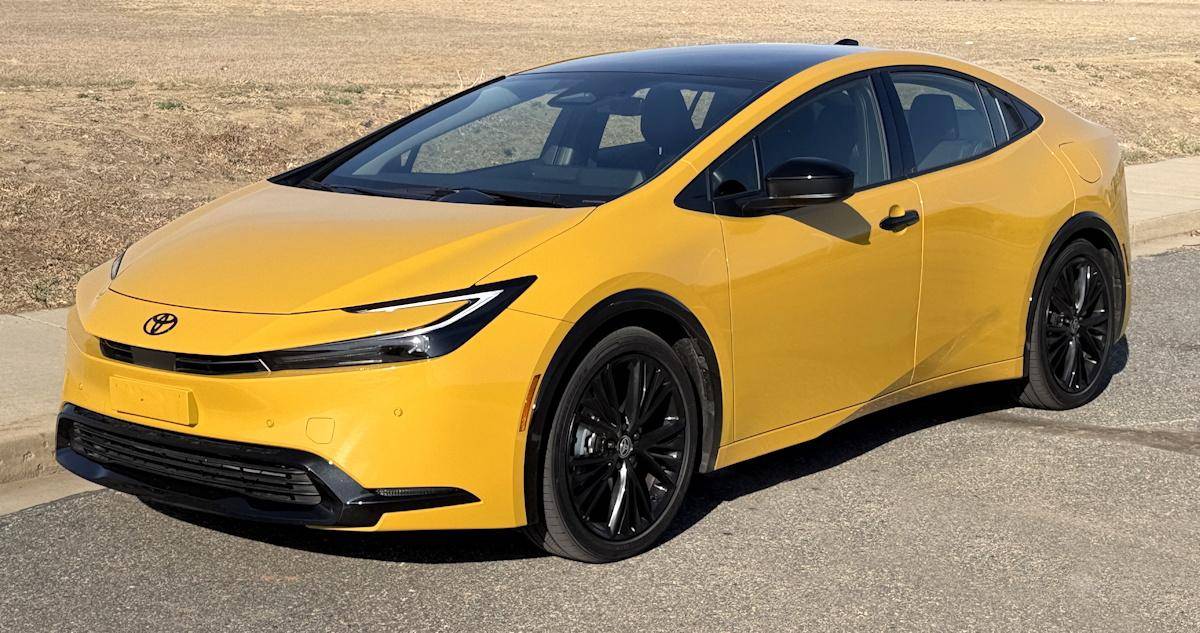
As Toyota rolls out the Nightshade edition across (most of) its lineup, I've had a chance to drive a couple of different, newly designed 2026 vehicles. When the list included the latest and greatest Prius, that piqued my curiosity; what had changed in twenty years of vehicle evolution? The company dropped off a "Karashi" 2026 Toyota Prius Nightshade PHEV for me to drive for a week:
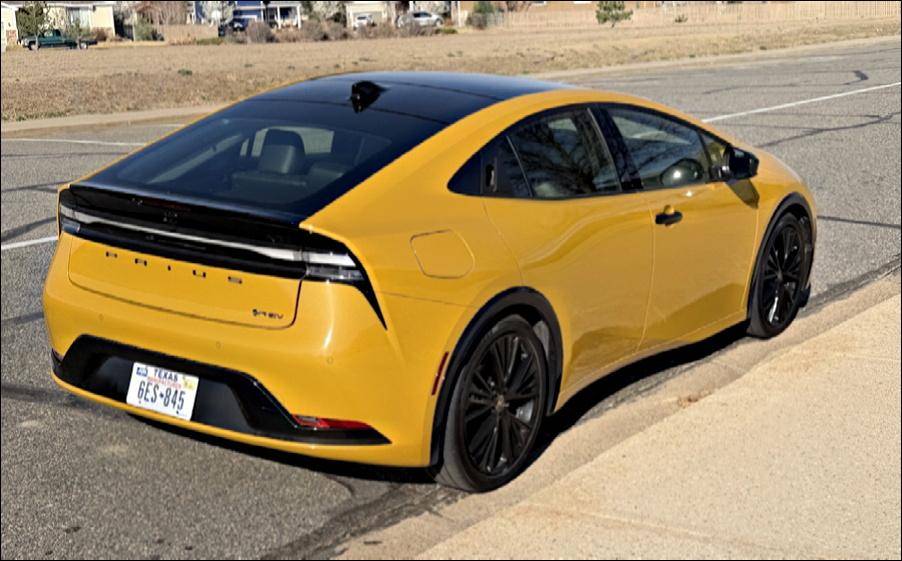
Karashi is an intriguing color, named after a Japanese hot mustard and exclusive to the Nightshade edition. It really does look like mustard yellow in person (the camera had a hard time with this particular shade of yellow, unfortunately, as you'll see across my photos), and so I promptly dubbed the vehicle "Mr. Mustard".
The 2026 Prius is indeed a sleek car, with a low, aggressive racing profile that at some angles looks almost like a simplified supercar. While the 2.0L 4-cylinder engine and 220 hp didn't deliver the oomph of a McLaren, it did have plenty of pep thanks to Toyota's excellent hybrid system and EV integration. It was definitely fun to drive, demonstrating that horsepower isn't the only important stat to consider when considering drive performance. As a low-slung vehicle with a low center of gravity, it was no surprise that it handled turns and winding roads with ease, making it a fun drive in the Rocky Mountains near my home.
It is low to the ground with a low roof, making this yet another car that can be uncomfortable to enter and exit. I'm over 6-feet tall, which undoubtedly contributed to the problem, but I found that I had to master a sort of step-in and rotate movement to be able to enter the Prius. Because it was so close to the ground - compared to, say, a typical SUV - getting out was also a challenge, involving me consciously leveraging myself up and out rather than just unthinkingly stepping out of the car. This is a complaint occasionally reported by other Prius owners in online forums, and an excellent example of why a test drive is so important as part of selecting a new car. I had the same complaint when I drove the 2023 Prius.
But let's get back to the 2026 Prius Nightshade...
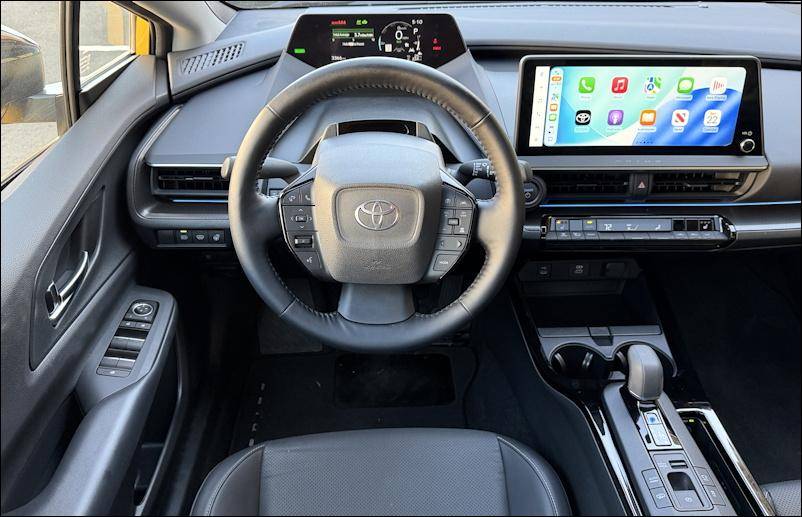
The interior features a simplified dash design with lots of buttons and controls, certain to keep the " don't force us to use a touchscreen " crowd happy. Indeed, the steering wheel has a heck of a lot of controls. It's also very sleek, as befitting the overall design language, with a main instrument cluster behind the steering wheel that's slim and very modern.
Look at the angles, and you'll see another issue I had with the Prius: I couldn't adjust the steering wheel so that the instrument cluster wasn't partially covered by the top of the steering wheel. It's really just not a car designed for taller drivers; if my head were 4-5" lower, I would have been able to see the display under the top portion of the steering wheel without an issue. As is, I had to shift my head left or right to check my speed, which was inconvenient.
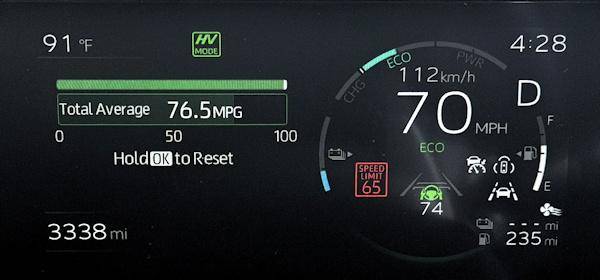
Having said that, the main instrument display was nicely laid out, though perhaps overly busy with a lot of information shown. My average fuel efficiency was a delightful 76.5 mpg, but that's because my initial 35 miles on EV only had already been depleted (the "- - -" on the lower right indicates EV-only range remaining). The ever-increasing EV range of PHEVs is intriguing because it really demonstrates how plug-in hybrids are a bridge between classic internal combustion engines and full EV: offering the best of both worlds.
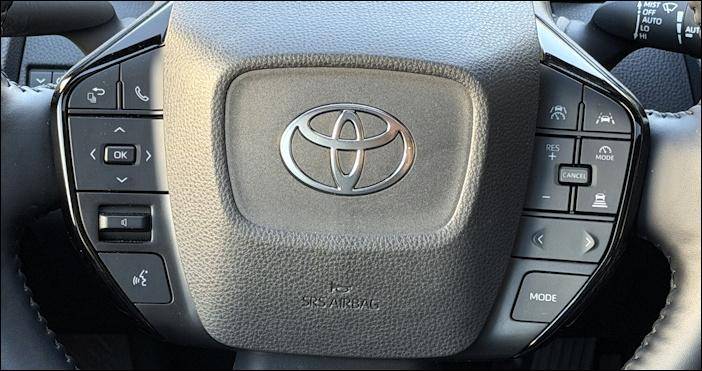
As mentioned earlier, there are a lot of buttons and controls on the steering wheel, reasonably symmetric, but somewhat oddly laid out. For example, the volume adjustment is the up-down toggle on the lower left, but the next/prev track control is on the lower right (as is the infotainment mode button). Something a driver will figure out quickly enough, but is this the optimal button layout?
I did really like the gear shift, offering a comfortable handle, though it is more accurately a shift-by-wire electronic selector: The shifter knob always reverts ot the same location once you've switched gears. With the vehicle's Toyota Continuously Variable Transmission, it's not letting you shift from 1st to 2nd, of course. The Prius features three drive modes: Eco, Normal, and Sport.
Adjacent to the gear selector is one of the more frustrating elements of the modern Prius: The Qi wireless phone charging slot. The concept is great, slip in your MagSafe-compatible phone, and it'll charge while keeping the screen away from your distractible vision, but in practice, it's surprisingly tricky to get the phone positioned correctly so it actually charges. I have an iPhone 17 Pro with a MagSafe case, and it never once charged when the phone was in the case. When I popped it out of the case and pushed it as far forward as possible, it would occasionally work properly. This is a complaint echoed by other Prius owners with this particular charger design. What's curious is that the Toyotas with a charging 'bed' design work perfectly with my phone, whether in its case or not. This might just need a design revision back at Toyota HQ.
Indeed, there's a perfect location for a Qi wireless charging pad if they just removed the charging slot:
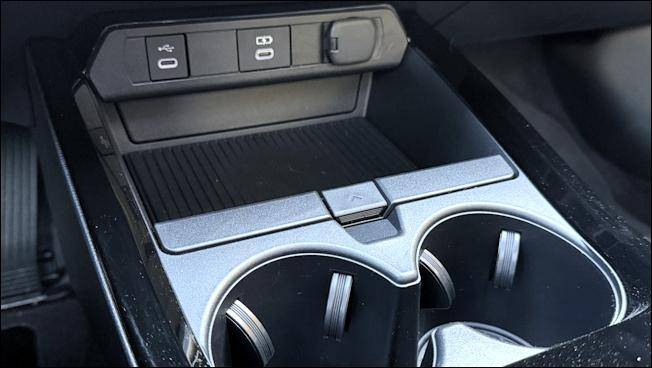
Instead, this area in front of the cup holders merely serves as storage space. A missed opportunity.
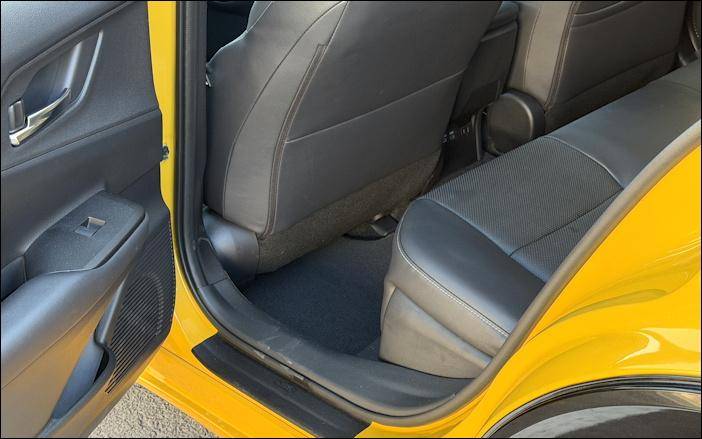
Rear legroom was a bit less than when I had a previous generation Prius, those many years ago; acceptable, but not particularly comfortable for an adult if the driver or front passenger is tall and pushes the seat back. According to industry stats, this generation Prius has a tight 34.8 inches of legroom versus the standard midsize sedan's 38 inches. For a tot or tween, not a big deal, but precious little space for a full-size human. 🤓
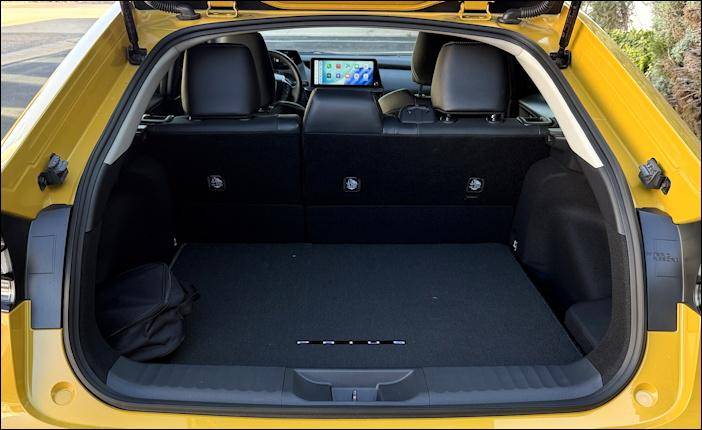
As with so much of the modern Prius design, the sleeker appearance comes at the cost of less cargo space, particularly with the hatchback being slimmed down. A previous gen Prius sported 27.4 cubic feet of cargo space, for example, while this model dropped down to 20.3 cubic feet. Fold down the rear seats, and that increases a fair bit.
There’s so much to like about the industry-leading plug-in hybrid tech of the 2026 Prius PHEV, but the redesign has, for many people, effectively turned it into a two-seater sports car for some drivers. Again and again, I was stymied by the trade-offs, from a phone charger that wouldn’t charge to limited cargo space, to rear-seat legroom that felt unacceptably tight for adults, to the gymnastics required to enter or exit the vehicle. If you’re looking for flexibility for a growing family, the Prius isn't a great choice, with both the Camry and the RAV4 far better options in the Toyota lineup. If it’s just you 95% of the time and you want a sporty, affordable sedan with some oomph that’s fun to drive, however, this might just be your next car.
2026 Toyota Prius Nightshade Plug-in Hybrid, powered by a 2.0L 4-Cylinder engine and CVT transmission. BASE PRICE: $37,795.00. Options included: Digital Key Capable, 12.3-inch Multimedia Display, Fixed Glass Roof, Key Gloves (for the keyfob. I kid you not), Alloy Wheel Locks, and Cargo Mat. AS DRIVEN: $41,304.00.
Disclosure: Toyota loaned me the Prius for a week in return for this candid write-up. This article originally appeared on PlanetDave.com with the title https://planetdave.com/2026/03/is-the-2026-toyota-prius-nightshade-phev-too-darn-sleek/ and is reprinted here with permission of the author.
Hey Dave Taylor wants you to share this!